There are two answers to how many photos you should take of a car for sale, and both are wrong for a dealership.
The portal answer is a minimum: eBay Motors says twelve, a UK remarketing auction says twenty-two.
The sales-floor answer is “more is better”, so shoot until your thumb hurts.
Neither comes with a shot list, a time budget, or a reason.
So the person photographing the car guesses, and the guess changes from car to car and from one salesperson to the next.
We’ve seen dealers publish eight photos of one car and forty-one of the next, with the main image shot from standing height in one and from the knee in the other. Buyers notice. They click the dealer whose listings all look the same, because that dealer looks like they know what they’re doing.
This is Autopix’s answer for a dealership in Norway or Sweden moving five to fifty cars a week. The number first, then the evidence, then the shot list, then the time it takes.
Start with the honest version: almost every figure you’ll find on this topic is vendor-published, American, and several years old. That does not make it useless. It means you read it as a direction, not a target.
Cox Automotive’s Power of Pictures study, run in 2016 and 2017 on US listing data, found that listings with multiple custom photos drew far more vehicle detail page views than listings with a stock image, and that views kept rising as photo counts rose through the 36 to 40 band and beyond.
The same study ranked which angles buyers consider: three-quarter views, side views, front and back corners, front seats, trunk and navigation screen all score highly.
Trader.ca’s dealer guidance draws a line at eleven. Listings with eleven or more photos see materially more detail page views and leads than listings with ten or fewer, so Trader recommends at least eleven and up to thirty per vehicle.
A WardsAuto column from the same era quotes Cars.com data showing a 170 percent increase in customer contacts once a listing passes eleven photos.
Then there’s the contrarian number…
A DealerRefresh forum thread reports a Ford conference presentation claiming nine photos produced a 71 percent higher lead submission rate than thirty-image listings. The explanation in the thread is the interesting part: fewer photos leave more questions, and questions turn into enquiries.
One dealer in the same thread tested eight to thirty photos and found shoppers scrolled through every single one, whatever the count.
Here is my reading of all of that: engagement rises with photo count.
Lead volume may not, because a listing that answers everything produces fewer “what does the boot look like” emails.
But those are low-value emails. The buyer who has already seen the boot and still calls is further along. Publish enough to answer the buyer, not enough to bury them.
Most guides treat these as the same number. They are not, and separating them is what makes the count manageable.
Shoot 25 to 30 frames per car. Publish 18 to 25. The frames you hold back are not gallery filler; they are answers. A close-up of the tyre tread, the service book stamps, the VIN plate, the kerb rash on the rear nearside wheel. You do not lead with them. You have them ready when a buyer asks, or you drop them into the listing later when the first enquiry tells you what people want to see.
Working rule: never publish fewer than fifteen on a used car over 50,000 km.
Below that count, buyers assume you are hiding something, and on an older car they are usually right to check.
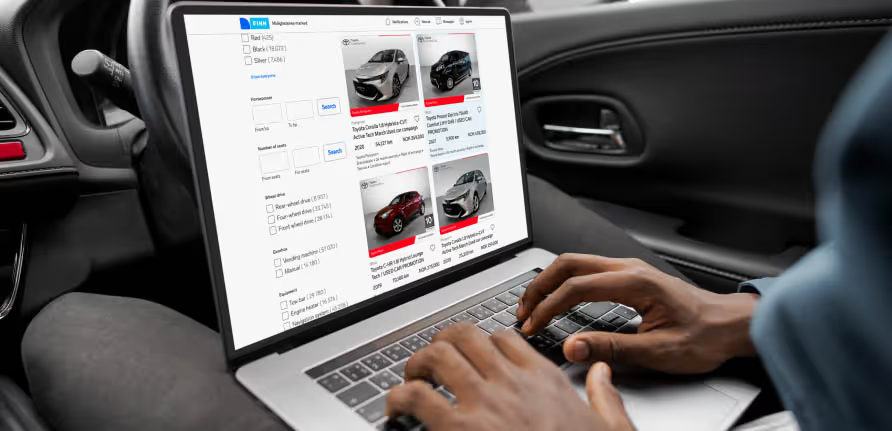
A quick sanity check from the home market. On 16 October 2026, I opened four listings from RSA Bil, one of Norway’s larger dealer chains, on FINN. They carried 14, 15, 23 and 24 photos.
That’s just four cars, but it puts a large Norwegian dealer in exactly the band this article recommends.
FINN’s own business resources, meanwhile, report that 93 percent of car buyers on the platform say photos are the first thing they look at in an advert.
If you are already shooting with a fixed sequence, you are most of the way there. If not, the free trial with three real orders is a cheap way to see what a consistent set looks like on your own stock.
This is the list. Twenty-one frames in the base set, with room for five optional ones. Shoot it in this order every time, and the order in the gallery takes care of itself.
Eight exterior frames cover every panel. If the car has a feature worth selling from the outside (a tow bar, a panoramic roof, factory alloys) that goes into the optional set.
The six-shot interior set is the same one I set out in Car Interior Photography Tips for Dealers, so I will not repeat the technique here.
The frames, numbered 9 to 14 in the full list, are: dashboard from the rear seat, driver’s seat and wear points, rear bench, boot, infotainment powered on, odometer.
The interior is where buyers check condition rather than looks. The sequence matters more than the lighting. Keep it fixed.
Proof frames are the ones that cut enquiry volume and raise enquiry quality. They are also the frames most dealers skip, because they feel like admissions. They are not.
A photographed scratch is a known scratch.
An unphotographed one is a reason to walk away at handover.
If there is no visible damage, do not invent photos to fill positions 18 and 19. Use those slots for something the buyer is getting: the winter wheels, the tow bar, the second key.
Every published frame should answer a question. If it adds nothing the previous frame did not, it does not belong in the gallery.
Winter wheels included in the price. Roof box. Tow bar. Third row of seats. Anything the listing title promises but the base set does not show.
The base set is for a used car with a story to tell. The count moves in three situations.
Nearly new stock, under 20,000 km and still under warranty, needs fewer proof frames. Buyers are not checking for wear.
Drop to eighteen and spend the saved frames on features.
Electric cars need two additions: the charging port with a cable in it, and the battery or charging information screen. Label that second frame for what it is.
A displayed range at full charge is not a certified battery-health reading, and a listing that presents it as one invites the first awkward question at handover.
In Norway, where a majority of used-car enquiries now involve an EV, those two frames answer the first two questions every buyer sends.
Vans and commercial vehicles flip the priority. Load space is the interior. Shoot it from the rear doors, from the side door, and with the bulkhead in frame. Payload plate, ply lining and tie-down points replace the dashboard and rear bench.
Private-seller platforms and dealer stock feeds differ too. A listing syndicated to several portals through a dealer management system usually carries a single gallery, so the order you set once has to work everywhere.
That is one more reason to fix the sequence rather than tailor it per car.
Give a buyer forty excellent photos in a random order, and you have handed them a job. Give them twenty in the right order, and you have walked them round the car.
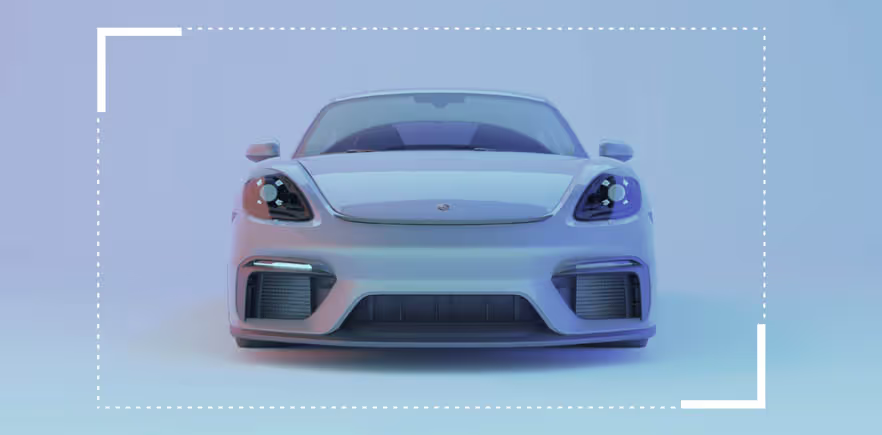
The main image is the front three-quarter, every time. It is the one frame that appears on the results page, and the results page is where the click decision is made, not the listing.
The next four frames should be three more exterior angles plus the dashboard, because the first five together decide whether the buyer keeps scrolling.
Proof frames go last. Buyers who reach them are already interested, and seeing the honest frames at the end reads as confidence rather than confession.
Then apply the same order to every car on the lot.
This is the point where the article stops being about one listing and starts being about the dealership. A results page showing forty of your cars, each with the same first frame, shot from the same height, on the same background, reads as one dealer.
The same forty cars with forty different first frames read as forty private sellers who happen to share a phone number.
Consistency across the inventory is the argument I would make to any dealer who asks whether photo count matters. It matters less than whether the count and the order are the same on every car.
Twenty-five photos sounds like a lot until you time it. With a phone, a fixed sequence, and a guide overlay showing where to stand, the base set takes three to four minutes per car.
The frames that take time are the ones you have to think about, so remove the thinking.
Where time really goes is editing. Twenty-five frames multiplied by twenty cars a week is five hundred images, and if each one needs even thirty seconds of cropping, straightening, and background work – that is over four hours a week spent in software rather than selling.
That is an illustrative calculation, not a measured average; your equipment and workflow set the real number. The shape of it holds, though. On the lot, the four-minute shoot is not the bottleneck. The edit is.
This is where Autopix sits in the workflow. The app’s smart photo guide shows the sequence and the framing for each frame, so the person shooting does not have to remember the list. Every frame then comes back edited, with a consistent background and the plate handled, within minutes rather than the next day.
The only decision left is Express, which is fully automated and starts from 89 kr per car, or Plus, which adds professional retouching and a human check at 149 kr per car. For a listing set of twenty-five, that choice is the entire editing decision.
If you want to see what the fixed sequence looks like on your own stock before changing anything, start with three real orders on the free trial.
Shoot three cars the way you shoot them now, and compare the galleries side by side with the ones that come back.
For a full day’s workflow built around the same idea, the volume guide in How to Photograph 20 Cars a Day covers lot sequencing and exposure, and the camera settings guide for dealers covers the phone and camera setup that makes the sequence repeatable.
Shoot it in that order on every car. Publish 18 to 25.
Keep the rest for the first buyer who asks. If the editing side of that list is what is holding you back, try Autopix on three real orders and see how the sequence looks when every frame comes back consistent.