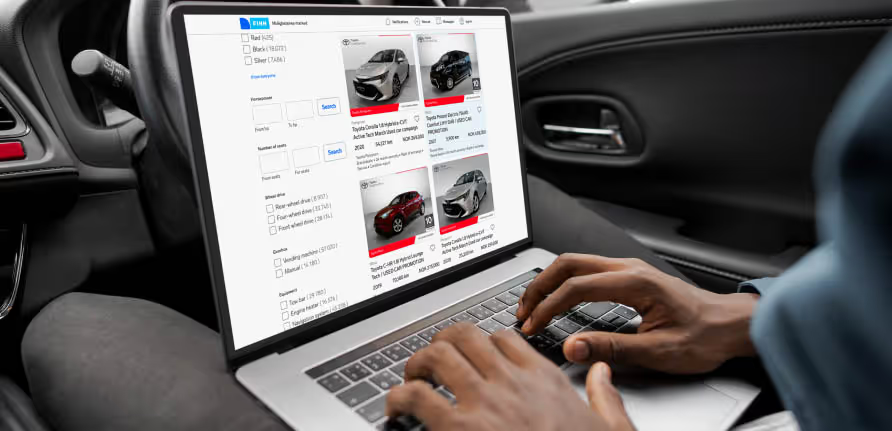
A used car costs you money every day it sits unsold. Floor plan, depreciation, the space it occupies, and the staff time it eventually takes.
The sale itself is rarely the hard part.
Getting the car from arrival to a live, credible listing fast enough to catch the buyers already searching for it is where small dealerships lose weeks.
Autopix works with dealerships across Norway, Sweden, and Denmark that move between five and fifty cars a week, and the pattern is consistent: The stock is fine. The prep is fine. The car sits for days waiting to be photographed properly.
This guide covers the routes available for selling a used car, then the process for the one that pays best: retailing it online yourself.
There are four realistic ways to move a used car:
Retailing online returns the most money and takes the most work. Trade and auction return less and clear the space in days. Most small dealerships need both, and the skill is knowing which car belongs in which channel on the day it arrives, not three weeks later.
For the retail route, the order that works is: check the paperwork, price against live listings, fix the cheap faults, clean it, photograph it properly, write a description that answers questions before they are asked, and publish.
Your own listing on the national marketplace, at a retail price, to a private buyer.
This is where the margin is, and it is where photography, description and response time decide whether the car moves in eight days or thirty.
A car that does not fit your forecourt profile, or one that has sat too long, is often worth more to a dealer who already sells that make and has a customer list for it.
Trade prices are lower for a reason, as the buyer absorbs the reconditioning, the advertising, and the risk of it not selling. Take that hit early rather than at day sixty.
Useful for two kinds of stock: something unusual where a bidding room finds a buyer you cannot, and something tired where you want it gone without fielding questions.
Check entry fees, commission, and the reserve the auction house wants before you commit.
Fast and predictable, with the caveat that the opening quote assumes a better car than the one that arrives. Read what triggers a deduction: tyre depth, service history gaps, kerbed wheels, warning lights, a missing second key.
A useful rule… decide the channel when the car lands.
Every car that drifts into retail by default, without anyone deciding it belongs there, is the car that goes to auction anyway, three weeks of depreciation later.
Registration certificate, service history, receipts for recent work, the roadworthiness inspection record, both keys.
Two gaps cost real money later: a missing service record, which is worth a call to the garage that did the work, and outstanding finance on a part-exchange, which needs a settlement figure before you can sell cleanly.
Search the same model, engine, year and transmission, with mileage within ten thousand kilometres. Take twenty listings, ignore the two extremes, and place your car in that range honestly. Full history, two keys and fresh tyres sit near the top.
A patchy record sits near the bottom, however well the car drives.
One practical point: buyers filter by price bracket.
A car worth 149,000 kroner, listed at 152,000, disappears from every search capped below 150,000. A three-thousand-kroner ambition can cost you the entire audience.
Small visible faults suggest neglect and invite a large discount.
Large mechanical faults are usually better disclosed and priced in than repaired, because you rarely recover the full cost of the work.
Worth doing: a blown bulb, a torn wiper blade, a chipped windscreen, cloudy headlight lenses, a full set of mats.
Usually not worth doing: bodywork, clutch, cambelt, air conditioning.
The pre-sale maintenance checklist covers where that line sits.
Door shuts, the boot floor under the mat, rubber seals, the inside of the windscreen, the wheels, and the smell.
Remove everything that makes the car look used rather than for sale, including the previous owner’s parking disc and phone holder.
Most buyers decide whether to enquire from the photographs alone.
Finn.no’s own figures, cited in Autopix’s guide to selling more cars online, show that 93 per cent of buyers look at the pictures before anything else and spend an average of one minute forty-five seconds on an advert, most of it on images.
Light. Overcast beats sunshine.
Direct sun creates hard reflections, blows out the bonnet and roof, and throws the photographer’s shadow across the door.
On a clear day, shoot early or late, or use open shade.
Background. A flat, empty, plain surface with the car in the middle of it. Other stock, bins, fencing and signage in the frame make a listing look careless even when the car is good.
Distance and height. Around three and a half metres back, phone held at the car’s waistline. Too close distorts the front end. Too high makes the roof dominate.
The shot list. Front three-quarter with the wheels turned slightly towards you, rear three-quarter, both flat sides, straight front, straight rear, all four wheels, dashboard with the ignition on so the mileage reads, front seats, rear seats, boot, engine bay, both keys, the service book open, and a close-up of every scratch, dent and kerbed rim.
That last group is the one dealers cut, and it’s the one that sells the car.
A buyer who sees the damage in the advert arrives expecting it. A buyer who finds it on the forecourt starts negotiating from suspicion, and that conversation costs more than the scratch ever would.
Shoot twenty to thirty images, publish fifteen to twenty. The phone photography guide and the camera settings guide go further on technique.
This is the step that breaks at volume. One person photographing one car in good light gets a strong result with a phone. Fifteen cars a week, shot by whoever is free, in Nordic winter light, in a yard with other stock behind them, produces a listing set that looks inconsistent even when every individual image is acceptable.
That is what Autopix was built for… a guided shooting sequence in the app, automatic editing and background replacement, and images that look like they came from the same place.
Three free orders on real cars, so testing it costs nothing.
Open with what buyers filter on: model, engine, year, mileage, transmission, drive.
Then the honest part.
Service history by date, recent replacements with the month, and every fault named plainly, including the ones the photographs show.
Skip the phrases that appear in every weak advert. “First to see will buy” tells a buyer nothing about the car.
The national marketplace, plus one social marketplace for local reach.
Listing on six platforms multiplies admin, not buyers. Keep the listing live rather than deleting and reposting, and if enquiries dry up after ten days, change the price or the photographs rather than the wording.
Response time is the part of the process most small dealerships underestimate. A buyer comparing four listings on a Sunday evening contacts all four and buys from whoever answers first with a straight answer.
Keep viewings in daylight with the documents ready.
On a test drive, check that insurance covers the driver, and accept a pre-purchase inspection at a workshop of the buyer’s choosing.
A buyer who pays for an inspection is a buyer who intends to buy.
Take payment as a confirmed bank transfer before the keys move, checked in your own banking app rather than on a screenshot. Then complete the change of ownership the same day.
In Norway, the seller submits the Notification of Sale online, and the buyer confirms it.
The Norwegian Public Roads Administration is explicit that until the buyer and any co-owner confirm, the seller remains responsible for the vehicle, and that the car should not be handed over before then.
See the Statens vegvesen notification of sale pages.
In Sweden, the change can be reported through the Transport Agency’s e-service and registered the same day, or on part 2 of the registration certificate, which must reach the agency within ten days of the transfer.
A dealer buying or selling a vehicle can usually handle the change of ownership on the customer’s behalf.
Details are on the Transportstyrelsen change of ownership page.
Days between arrival and listing. Every one of them is depreciation with no advert running.
Inconsistent photography. A results page shows your cars next to each other. Fifteen listings that look like fifteen different sellers undermine all of them.
Hidden faults. Found on the forecourt, at the worst possible moment, turning a price conversation into a trust conversation.
Retail by default. Cars that should have gone to trade in week one and went to auction in week six instead.
Pick the two cars on your forecourt that have been there longest. Decide honestly whether either one is retail stock or whether it should have gone to trade on day three.
Then reshoot the one that stays: flat light, plain background, thirty frames, fifteen published.
If photography is the step that keeps slipping, try Autopix on the next car that arrives. Three free orders, on real vehicles, not a demo image.